

Peec.ai is one of those products that looks like magic from the outside:
- “Track my brand in ChatGPT, Perplexity, and Google AI Overviews”
- “Tell me where I rank, how I’m perceived, and who gets cited”
- “Give me a dashboard, exports, and recommendations”
But if you look closer, it's not magic. It's a pipeline.
And the pipeline is… extremely buyable.
Let's take a closer look.
What Peec is selling (in primitives)
Peec’s UI is a marketing wrapper around a small set of repeatable primitives:
- Prompt runs: “Ask this question” on a schedule.
- Models: ChatGPT / Perplexity / AIO (and paid add-ons like AI Mode, Claude, etc.).
- Answers: raw text responses.
- Citations / sources: URLs referenced by the model (or the AI surface).
- Brand extraction: does the answer mention your brand / competitors?
- Position: where your brand appears in a list, or the order it's recommended.
- Sentiment: how the answer frames your brand.
Once you have those primitives, everything else is aggregation:
- “Visibility” = fraction of runs where your brand is mentioned
- “Position” = average rank / position across runs
- “Sources” = histogram of cited domains and URLs
The pricing tells you the architecture
Here’s the biggest tell.
Peec’s plans advertise AI answers analyzed per month.
If you do the math, the numbers snap perfectly to:
answers/month ≈ prompts × models × 30
With their default bundle of 3 models (ChatGPT, Perplexity, AIO):
- Starter:
25 × 3 × 30 = 2,250 - Pro:
100 × 3 × 30 = 9,000 - Enterprise:
300 × 3 × 30 = 27,000
That’s not an accident.
It strongly suggests an internal model like:
- 1 “AI answer” = 1 upstream provider call
- They meter you on provider calls, not on “prompts” (prompts are just the configuration layer)
The two providers Peec is using (model support is 1:1)
Peec’s “supported models” list maps one-to-one to upstream provider capabilities:
In practice, that collapses to two vendors:
- SerpApi for Google AI surfaces (AI Overviews and AI Mode)
- Pricing:
serpapi.com/pricing
- Pricing:
- DataForSEO for AI Optimization “LLM responses” (ChatGPT, Perplexity, Claude, Gemini, …)
Here’s the mapping at the “what do you pay for?” layer:
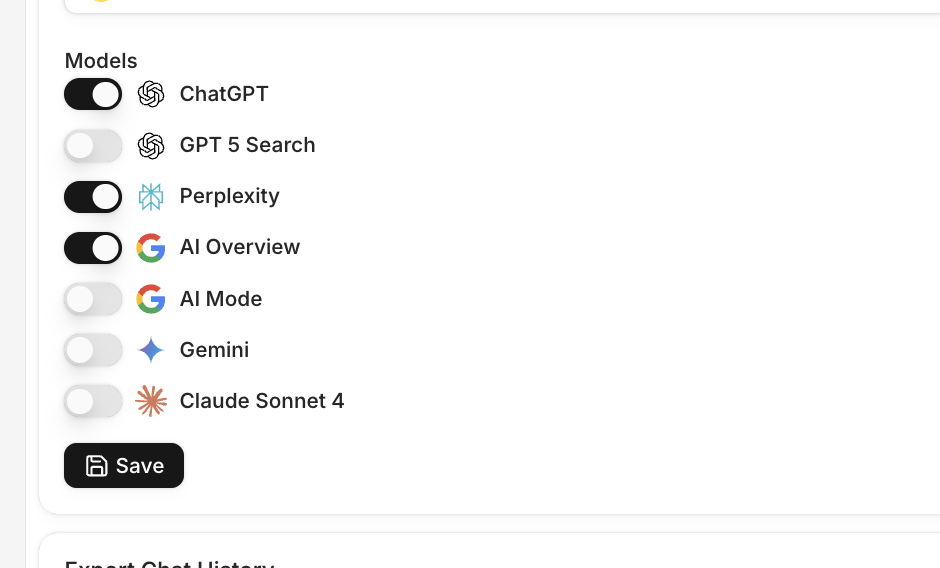
Every toggle is a billable upstream integration. This is why “add more models” is an easy upsell: it’s literally more paid adapters.
| Peec model toggle | What it really is | Typical upstream |
|---|---|---|
| ChatGPT | LLM response + citations | DataForSEO LLM Responses |
| GPT 5 Search | ChatGPT-style response with web search enabled | DataForSEO LLM Responses |
| Perplexity | LLM response + citations | DataForSEO LLM Responses |
| Gemini | LLM response + citations | DataForSEO LLM Responses |
| Claude (Sonnet) | LLM response + citations | DataForSEO LLM Responses |
| AI Overview | Google AI surface answer + references | SerpApi (Google AI engines) |
| AI Mode | Google AI Mode answer + references | SerpApi (Google AI engines) |
This is also why Peec can sell “add AI Mode / Claude / Gemini / … for an additional fee”: those are new upstream endpoints with new marginal COGS (and a very clean way to price discriminate).
The minimal pipeline (aka: what you actually have to build)
If you wanted to ship “Peec-lite” in a weekend, the backend is basically:
- Store configuration
- Project: brand name + domain + location
- Prompt list (+ tags/topics)
- Enabled models
- Schedule runs
- Daily cron creates a job for each
(prompt, model)
- Daily cron creates a job for each
- Fetch answers
- For each job: call the provider API and normalize into:
- answer text
- citations / sources
- metadata (timestamp, raw payload)
- For each job: call the provider API and normalize into:
- Extract signals
- brand mentions (simple string/domain matching gets you surprisingly far)
- sentiment (small model call or heuristic)
- “position” (detect list structure and rank order)
- Store facts
- run facts, mention facts, citation facts
- Aggregate for UI
- visibility/position trends, source tables, recent chats
The hard part isn’t the algorithm. It’s product: workflows, dashboards, collaboration, exports, and the “what should I do next?” recommendations.
Cost analysis: how much of €199 is just paying other people?
Let’s run the “standard” scenario you asked for:
- Plan: Peec Pro (€199 / month)
- Config: 100 prompts
- Models included: 3 (ChatGPT, Perplexity, AIO)
- Cadence: daily
That’s:
100 × 3 × 30 = 9,000 answers/month
Which decomposes into roughly:
- 3,000 AIO answers (Google AI Overviews-style surface)
- 3,000 ChatGPT answers
- 3,000 Perplexity answers
AIO COGS (SerpApi-shaped)
If AIO is implemented using SerpApi-style AI surfaces, you’re buying “searches”. SerpApi’s public plans are tiered by searches/month (pricing).
Back-of-the-envelope:
- 3,000 AIO calls/month fits under a 5,000 searches plan (if you were buying at retail)
- That implies an AIO cost on the order of $0.01–$0.02 per answer at small scale, and typically less when pooled across many customers
ChatGPT/Perplexity COGS (DataForSEO-shaped)
DataForSEO’s AI Optimization “LLM responses” endpoints are billed per request and the API returns explicit cost fields (see their overview docs: LLM responses overview).
Even if you don’t know the exact unit price ahead of time, you can do a very useful calculation:
Break-even cost per non-AIO answer
Revenue per answer on Pro is:
€199 / 9,000 ≈ €0.022 per answer
But AIO isn’t free. If you reserve, say, €30–€60 of that plan to pay for the AIO provider calls, you’re left with:
- remaining revenue: €139–€169
- remaining answers: 6,000
So your break-even for the other two models is roughly:
€139..€169 / 6,000 ≈ €0.023..€0.028 per answer
If your blended upstream cost for ChatGPT+Perplexity is below ~€0.025 per response, the Pro plan has positive gross margin before you count your own infra and any sentiment/extraction model calls.
Sensitivity table (illustrative)
This is the lever: DataForSEO cost per LLM response. Below is a “what if” table using the Pro plan volumes and a conservative €45/month allocation for AIO calls.
| Assumed DataForSEO cost / response | DataForSEO COGS (6,000) | Total COGS (AIO + DataForSEO) | Gross margin on €199 |
|---|---|---|---|
| €0.005 | €30 | €75 | ~62% |
| €0.010 | €60 | €105 | ~47% |
| €0.020 | €120 | €165 | ~17% |
| €0.025 | €150 | €195 | ~2% |
| €0.030 | €180 | €225 | negative |
Two things make this even more margin-friendly in practice:
- Pooling: Peec buys provider capacity once and amortizes it across customers (retail plan pricing overstates COGS).
- Metering: the “answers/month” limit is exactly how you prevent power users from exploding your bill.
Also: “Unlimited seats” and “Unlimited countries” are mostly a pricing/positioning decision — they don’t materially increase per-answer COGS.
TAM: who pays for “AI search analytics”?
This category is basically “SEO tooling for the LLM era”. So the TAM is the set of orgs that:
- already spend on SEO / content / brand, and
- believe AI surfaces are a meaningful acquisition channel (or a brand risk).
A bottom-up way to think about it
TAM = N_accounts × ARPA
Where ARPA here is plausibly in the €1k–€20k/year range:
- Starter: ~€1k/year
- Pro: ~€2.4k/year
- Enterprise: €6k/year and up (often much higher once add-ons + services land)
Likely segments (and why they buy)
- Agencies
- They have the strongest willingness to pay because they can resell “AI visibility reporting” as a line item.
- They also need multi-brand workflows, exports, and client-ready dashboards.
- B2B SaaS marketing teams
- Especially categories with “best X software” style prompts (CRMs, infra tools, payroll, analytics, etc.).
- They care about competitor benchmarking and source/citation analysis.
- Consumer brands with large awareness budgets
- Less about conversion, more about “what does AI say about us?” and PR/brand safety.
What’s “addressable” (SAM) vs theoretical (TAM)?
If you filter down to teams that both have budget and care about AI search today, your SAM is smaller than your TAM.
But the trend line is obvious: as more product discovery moves to AI surfaces, this becomes “normal SEO tooling”, not a niche.
Closing thought
Calling Peec “a fancy SerpApi + DataForSEO wrapper” is not an insult — it’s the business model.
The defensibility isn’t the API calls. It’s the workflow, the data model, and the fact that most teams would rather pay €199/month than build the pipeline themselves.